Less Clutter.
More Comfort.
One Smart Bin.
The world's first bathroom bin that doubles as an ergonomic toilet stool. Declutter your space. Improve your health. Both in style — and invisible.
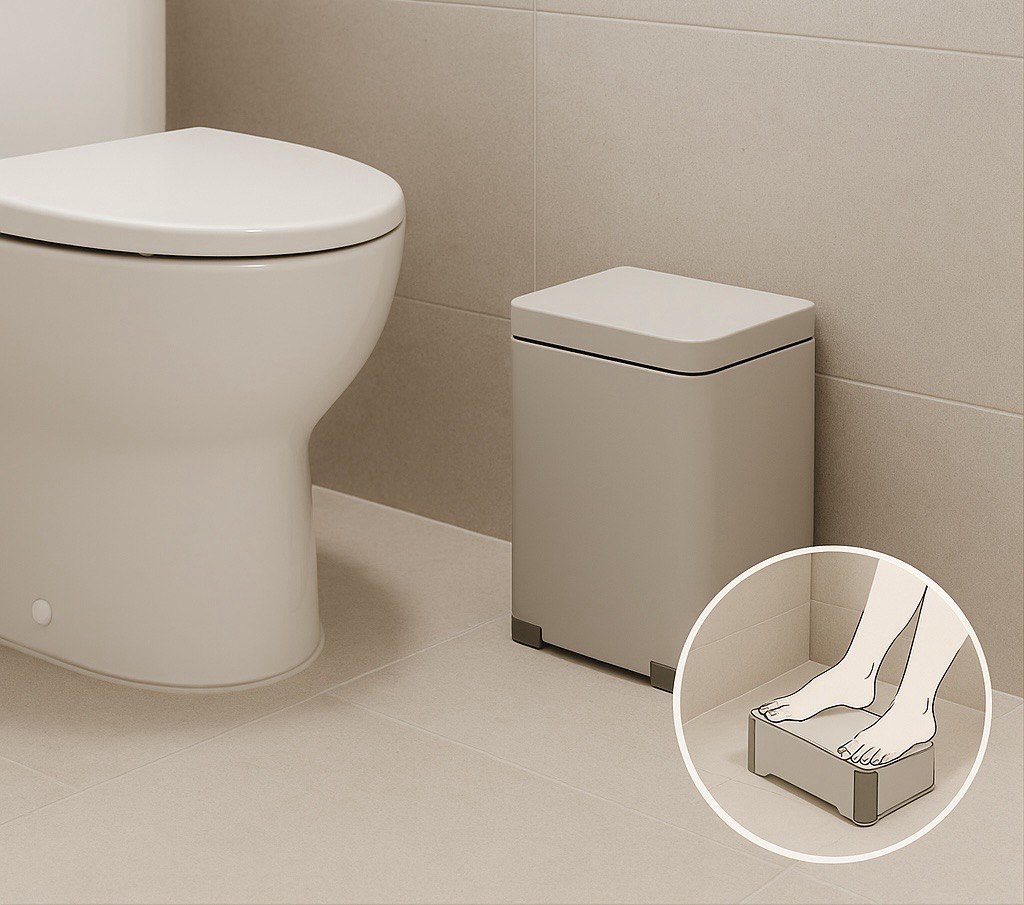
The world's first bathroom bin that doubles as an ergonomic toilet stool. Declutter your space. Improve your health. Both in style — and invisible.
The natural squat position has been used by humans for thousands of years. Modern toilets changed that — Releasy brings it back.
Elevating your feet to a 35° angle straightens the anorectal angle, allowing for a smoother, more natural bowel movement.
Studies show the squatting position reduces straining by up to 50%, lowering the risk of hemorrhoids and pelvic floor issues.
Research published in the Journal of Clinical Gastroenterology found squatting reduces time on the toilet and improves emptying.
Complete elimination reduces bloating, discomfort, and supports a healthier digestive system over time.
Especially beneficial during pregnancy when constipation is common. Reduces pressure on the abdomen and pelvic floor.
From children to seniors — the ergonomic position helps everyone. Particularly valuable for those with mobility or digestive issues.
Join the waitlist and be first in line.
The science behind posture, the history of how we got here, and what cultures around the world have known for centuries.
What peer-reviewed research tells us about the relationship between toilet posture and digestive health.
Read more →From ancient Rome to Victorian England — how a 150-year-old design choice affects billions of people today.
Read more →Japan, India, the Middle East — two-thirds of the world never adopted the Western sitting toilet. Here's why.
Read more →What peer-reviewed research tells us about the relationship between toilet posture and digestive health.
At the core of the posture discussion is a muscle called the puborectalis. When seated upright at a standard toilet height (40–42 cm), this muscle maintains a kink in the rectum — an anorectal angle of approximately 100°. This kink is essential for continence, but it also means that elimination requires active effort to overcome.
When the knees are elevated above the hips — as in a squat or when using a footstool — the anorectal angle opens to approximately 126°, creating a straighter pathway. This is not opinion; it has been confirmed through defecography (X-ray imaging during evacuation) in multiple clinical studies.
Sikirov, 2003 — Digestive Diseases and Sciences: A study of 28 healthy volunteers compared three positions: sitting on a standard toilet, sitting on a low toilet, and squatting. Results showed that squatting led to significantly shorter evacuation times (average 51 seconds vs. 130 seconds sitting) and subjects reported a greater sense of complete emptying.
Sakakibara et al., 2010 — Lower Urinary Tract Symptoms: Using anorectal manometry and electromyography, researchers demonstrated that hip flexion beyond 60° relaxes the puborectalis muscle more effectively, reducing the need for straining.
Modi et al., 2019 — Journal of Clinical Gastroenterology: In a study of 52 participants using a posture-modification device, 90% reported reduced straining and 71% reported faster bowel movements. The authors concluded that "a simple posture modification device improves bowel function in a healthy population."
PMC Scoping Review, 2025: A comprehensive review across multiple databases found consistent evidence that squatting reduces straining, requires less abdominal pressure, and is associated with improved bowel evacuation compared to standard sitting.
Chronic straining during defecation is a recognized risk factor for several conditions:
The clinical evidence consistently points to a straightforward intervention: elevating the feet during defecation to simulate a squat-like posture. This does not require replacing existing toilets — a well-designed footstool placed at the base is sufficient to achieve the biomechanical benefit. Releasy integrates this function into a product that already belongs in every bathroom.
Join the waitlist for early-bird pricing.
From ancient civilizations to the Victorian flush — how a 150-year-old design choice reshaped human health.
For the vast majority of human history, people squatted. Archaeological evidence from Mesopotamia, the Indus Valley, and ancient Rome shows that early sanitation systems — remarkably sophisticated for their time — were all designed around the squat position. The Roman latrinae, ancient Greek facilities, and the elaborate drainage systems of Mohenjo-Daro (circa 2500 BCE) all accommodated this natural posture.
The human body evolved over millions of years to eliminate in this position. The modern pedestal toilet is, by comparison, an extremely recent invention.
The sitting toilet as we know it emerged in the late 18th century. Alexander Cumming patented the S-trap in 1775, and the design was refined throughout the 1800s. But the real turning point came during the Victorian era, when industrialization and urbanization created an urgent public health crisis.
The Great Stink of London in 1858 — when the Thames became an open sewer — accelerated the construction of modern sewage systems. The pedestal toilet became the standard, not because of any health advantage in posture, but because it connected efficiently to indoor plumbing and was considered more "civilized" by Victorian standards.
George Jennings' public flush toilets at the Great Exhibition of 1851 cemented the design in the public imagination. By the early 20th century, the raised, chair-height toilet had become the global symbol of modern sanitation — exported through colonialism and industrialization to much of the world.
It is important to note that the pedestal toilet was adopted for reasons of sanitation infrastructure, social convention, and manufacturing efficiency — not because anyone studied its effect on human physiology. The health implications of changing humanity's elimination posture were simply never considered.
It was not until the late 20th century that researchers began systematically studying the biomechanical differences between sitting and squatting. The findings have been consistent: the posture our infrastructure encourages is not the posture our bodies were designed for.
No one is suggesting we abandon modern plumbing. The flush toilet is one of the greatest public health achievements in history. But we can acknowledge that its standard height — designed for plumbing convenience, not anatomy — creates a biomechanical compromise. A simple elevation of the feet resolves this entirely, restoring the natural posture while keeping every benefit of modern sanitation.
Join the waitlist for early-bird pricing.
Two-thirds of the world never adopted the Western sitting toilet. Their reasons go far beyond tradition.
Japan offers a fascinating case study. The traditional Japanese toilet — the washiki — is a squat-style fixture that was standard in homes, schools, and public facilities well into the late 20th century. Even today, squat toilets remain in many train stations, temples, and older buildings.
What makes Japan particularly interesting is that when Western-style toilets were introduced after World War II, adoption was slow. By 1977, sitting toilets finally outsold squat models — but the transition took decades, and many Japanese maintained a cultural preference for the squat position, associating it with cleanliness and health.
Japan then took the sitting toilet and reinvented it entirely — adding bidet functions, heated seats, and sophisticated hygiene features. But the underlying posture issue remained. Today, many Japanese homes and hotels offer both options, and there is a growing movement to recombine the ergonomic benefits of the squat with the comfort of modern fixtures.
Across India, Bangladesh, Thailand, Myanmar, and much of Southeast Asia, the squat toilet remains the norm — not due to a lack of development, but because of deeply held cultural practices around hygiene and health. In Ayurvedic medicine, the squatting posture has been recommended for digestive health for thousands of years.
India's experience with the Swachh Bharat (Clean India) mission, launched in 2014, is instructive. While the campaign focused on building toilet infrastructure, many implementations retained the squat design — recognizing both cultural preference and the practical health benefits of the posture.
Throughout the Middle East, squat toilets are common in both public and private settings. Islamic hygiene practices (known as tahara) emphasize thorough cleaning and natural posture. Many modern Middle Eastern homes feature both sitting and squat-style facilities, giving residents the choice.
When viewed globally, it is the Western sitting toilet — not the squat position — that is the exception. Roughly 1.2 billion people worldwide still use squat-style toilets as their primary fixture. The sitting posture is dominant primarily in Europe, North America, and Australia — regions where Victorian-era plumbing conventions set the standard.
This is not a question of developed versus developing. Singapore, Japan, South Korea, and the UAE — some of the world's most advanced economies — all maintain squat toilets alongside or integrated with modern fixtures.
The insight from global toilet culture is clear: the human body benefits from a squatting posture during elimination, and most of the world has never stopped using it. The challenge in Western countries is not convincing people to squat on the floor — it is providing a discreet, elegant way to achieve the same biomechanical position within the existing bathroom environment.
This is precisely what Releasy was designed to do.
Join the waitlist for early-bird pricing.
One product. Two functions. Zero clutter. Releasy fits seamlessly into any modern bathroom.
Unlike bulky squatty potties that sit awkwardly beside your toilet, Releasy is a beautiful bathroom bin that hides its secret in plain sight.
Early-bird pricing from €49. Free shipping in the EU.
Upgrade your workplace bathrooms. Show employees you care about their wellbeing — even in the most private moments.
Companies invest in standing desks, ergonomic chairs, and meditation rooms. The bathroom — used several times per day — gets nothing. Until now.
Get in contact with us and we offer you a unique distribution channel. Be the only facility in your region that is served by us and stand out from your competitors. Health matters for your customers.
10+ units with optional custom branding.
Pre-order now at early-bird pricing. Limited first batch.
Early bird — regular price €69
Save €9 — one for each bathroom
10+ units — custom branding available
From concept to your bathroom. Here's where we are.
Product design finalized. Ergonomic testing with physiotherapists. Material selection complete.
First physical prototypes produced. User testing with early supporters. Final refinements based on feedback.
Releasy page live. Collecting early bird pre-orders to validate demand and scale up production.
First batch manufacturing begins. Quality control and certification (CE, EU materials compliance).
Early bird orders ship first. Worldwide delivery. Retail partnerships begin.
Tell us about your needs and we'll get back to you with a tailored offer.
✅ Thank you! We'll get back to you within 48 hours.
Join the waitlist and secure early-bird pricing. No payment required — just your email.
🎉 You're on the list! We'll notify you when pre-orders open.